DTF Transfers vs HTV for Cotton Etsy Tees (2026 Buyer’s Guide)
Cost per print, durability expectations, equipment paths, and when each method wins—so you stop guessing and start matching method to design.
If you’re selling custom cotton tees on Etsy, you’ll hit the same fork early: heat transfer vinyl (HTV) or direct-to-film (DTF) transfers.
Both decorate cotton. Both need a heat press for consistent results. They are not interchangeable for every design, margin, or workflow. This guide compares them for real Etsy use—cost per print, durability expectations, equipment, when each wins, a beginner path, and common money-wasting mistakes.
We did not run private wash labs or invent “we pressed 500 shirts” rankings. Numbers below are approximate ranges drawn from publicly listed supplier pricing, manufacturer application guidance, and commonly published seller cost writeups as of 2026. Your blank brand, press calibration, and wash care will move results—always test on your own materials.
Quick comparison
| Factor | HTV (cut vinyl) | DTF (film transfers) |
|---|---|---|
| Best design type | 1–2 solid colors, text, simple logos | Photos, gradients, multicolor art |
| Typical material cost / print* | Often $0.50–$2 for simple designs | Often $2–$5+ per ready transfer (lower per design on gang sheets) |
| Labor per unit | Cut + weed + press (can be 5–15+ min) | Align + press + peel (~2–3 min once stocked) |
| Startup gear | Cutter + press + vinyl (~$235–$700 common range) | Press only if buying transfers; $1,500–$5,000+ for in-house printer setups |
| Cotton compatibility | Excellent with quality PU HTV | Excellent on cotton, blends, many other fabrics |
| Specialty finishes | Glitter, puff, flock, holographic | Full-color print; specialty finishes less common |
| Feel | Thin raised film (varies by brand) | Thin printed film / soft hand (varies by transfer) |
*Approximate ranges compiled from publicly available 2025–2026 supplier price lists and seller cost writeups—not a lab quote. Gang-sheet DTF and bulk vinyl shift the math.
Affiliate link — Amazon · Affiliate link — brand store
As an Amazon Associate, PressDesk may earn from qualifying purchases.
Who this guide is for
You’re in the right place if you:
- Sell (or plan to sell) cotton or cotton-blend tees on Etsy
- Already own—or will buy—a 15×15 heat press
- Need an honest pick between weeded HTV and press-and-go DTF
- Care about margins and time, not just “which looks cooler in a TikTok”
Look elsewhere (for now) if you:
- Only do all-over polyester sublimation (different lane)
- Already run a commercial DTG line
- Need screen-print volume economics for hundreds of identical units
Cost per print: the real Etsy math
HTV cost stack
- Vinyl — often a few dollars per sheet/roll; a simple chest logo may use ~$0.50–$2 of material
- Labor — weeding is the hidden cost. One-color text is fast; three colors with tiny islands is not
- Failures — mis-weeds, bad pressure, and wrong temp eat blanks
When HTV is cheapest: one-off and tiny batches of simple designs, especially if you already own a Cricut/Silhouette.
DTF cost stack (bought transfers)
- Transfer price — commonly discussed in the $2–$5 band for typical adult chest prints; suppliers also sell by sq. in. or gang sheets
- Shipping / turnaround — build this into listing lead times
- Labor — mostly press time once transfers arrive
When DTF is cheaper in practice: multicolor or photo designs where HTV weeding would take longer than the transfer premium—or any repeat SKU you can gang-sheet.
In-house DTF printers
Purpose-built or converted setups often land in the ~$1,500–$5,000+ range before maintenance, ink, powder, and film. That only pencils out when volume is steady. Most Etsy beginners should buy transfers first, validate demand, then consider a printer.
Rough decision cue
| Order profile | Lean toward |
|---|---|
| 1–10 shirts, 1–2 colors, text/logo | HTV |
| Same multicolor design, 10–50 units | DTF (gang sheet or pack) |
| Photo / gradient / 5+ colors | DTF |
| Glitter / puff / flock look | HTV specialty vinyl |
| Validating a brand with <$500 gear budget | HTV or DTF transfers + press (no printer yet) |
Durability (honest expectations)
Public claims vary widely: some HTV brands and seller writeups cite 50+ washes with proper care; some DTF suppliers advertise 50–100 wash cycles under test conditions. Treat every “X washes” number as conditional—correct temp, pressure, peel type, fabric, and customer care matter more than the method name.
Practical takeaways for Etsy:
- Both methods can ship durable cotton tees when pressed to the material chart
- Edges and thin details fail first on either method if pressure/temp is off
- Hot washes, high dryer heat, and fabric softener shorten life—put care cards in every package
- Do a wash test on your exact blank + material before scaling a bestseller
We are not claiming one method always outlasts the other in every shop. Consistency and instructions beat brand loyalty.
Equipment needed
HTV path
- Cutting machine (Cricut Explore/Maker class, Silhouette, etc.)
- Heat press (prefer true 15×15 for adult tees)
- HTV rolls/sheets, weeding tools, PTFE sheet
- Optional: infrared thermometer, heat gloves
DTF path (transfers first)
- Heat press (same 15×15 recommendation)
- Ready DTF transfers from a supplier
- PTFE sheet; follow hot/cold peel instructions per transfer
- No cutter required for application
DTF path (in-house later)
- DTF printer + powder / curing workflow (or integrated unit)
- Film, ink, adhesive powder, RIP software as required
- Ventilation / workspace discipline—follow manufacturer safety guidance
Affiliate link — Amazon heat press · Affiliate link — HTV starter · Affiliate link — weeding tools
When each wins
HTV wins when…
- Designs are simple and color-limited
- You want specialty finishes (glitter, puff, holographic)
- You’re making true one-offs and already own a cutter
- Material cost must stay tiny and you’re willing to weed
DTF wins when…
- Art is full-color, photographic, or gradient-heavy
- You need fast press-only fulfillment after transfers arrive
- You’re repeating the same SKU and can use gang sheets
- You sell on cotton and mixed fabrics without changing methods
Hybrid shops (common and smart)
Many Etsy sellers keep HTV for names/numbers/simple logos and DTF for hero multicolor designs. That is not indecision—it’s matching method to SKU.
Rule of thumb: If weeding would take longer than the DTF premium for that design, stop weeding—order the transfer.
Beginner path (recommended)
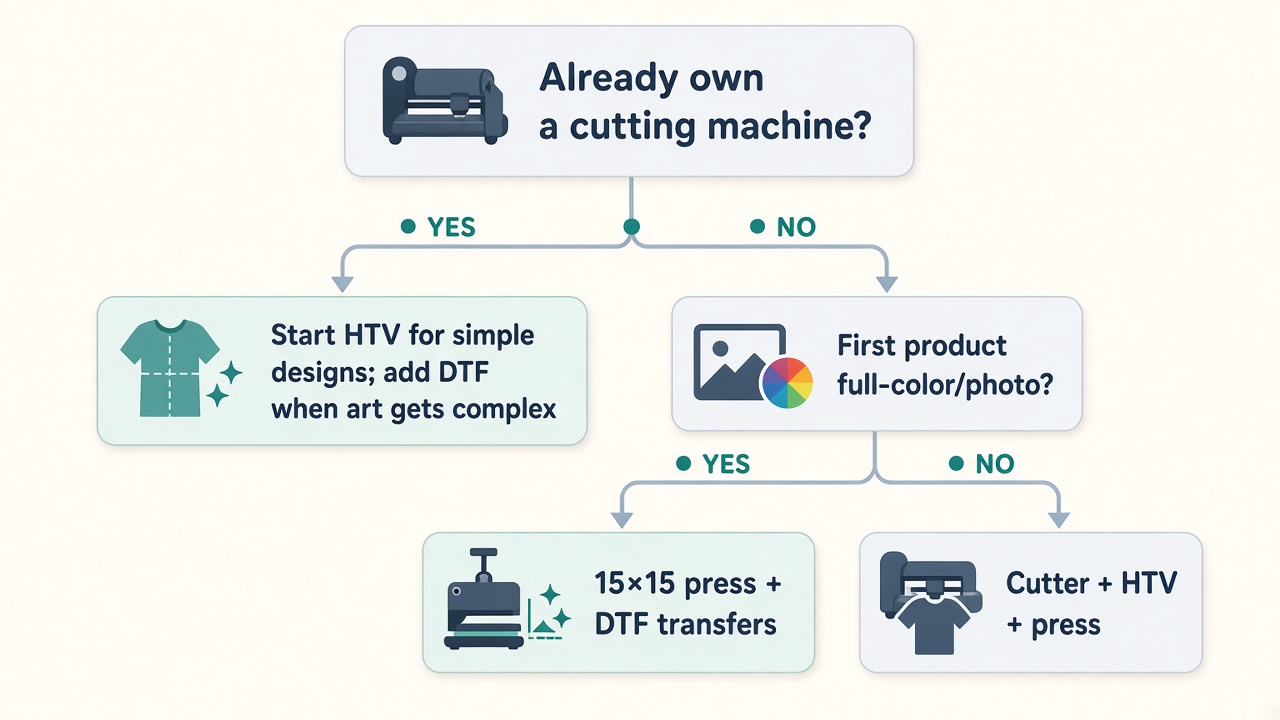
Do you already own a cutting machine?
-
Yes
HTV first — simple designs now; add DTF transfers when art gets complex.
-
No — first product is full-color / photo-based
15×15 press + DTF transfers — skip buying a DTF printer at the start.
-
No — simple one-color or name/number work
Cutter + HTV + press — classic low-risk apparel start.
- Week 1–2: Pick one blank brand/SKU. Dial time/temp/pressure with scraps.
- Week 3–4: List 3–5 designs max. Photograph the exact blank you ship.
- Before scaling: Wash-test bestsellers; write care instructions into every order.
Feel, photos, and returns (Etsy-specific)
Customers rarely complain about “HTV vs DTF” by name. They complain about crack, peel, stiffness, and photos that don’t match the hand-feel.
Listing photos: Shoot the exact blank and method you ship. Soft-hand DTF can look flatter in photos than glitter HTV; set expectations in the description (“smooth print finish” vs “raised vinyl”).
Returns risk reducers:
- Include wash/care cards (cold wash, inside-out, low dry / hang)
- Avoid promising “forever” durability—promise correct application + care
- Re-test when you change blank brands or transfer suppliers
- For oversized full-chest prints, warn that large films feel different than small logos
Margin note: A $2 DTF transfer on a $28 tee is often easier to defend than three layers of HTV that took 20 minutes to weed—price your time.
Press settings: follow the chart, not vibes
Both methods fail the same way when beginners improvise:
- Pre-press the garment briefly to remove moisture
- Use the supplier’s time / temp / pressure / peel for that SKU
- Use a PTFE sheet; don’t guess with random parchment quality
- Spot-check platen temperature if results drift across a batch
If you already followed our 15×15 heat press guide, keep that press—you do not need a different machine to switch from HTV to DTF transfers.
Common mistakes
- Buying an in-house DTF printer before you have demand — transfers validate first
- Using a household iron for customer orders — inconsistent pressure = returns
- Ignoring peel instructions (hot vs cold) — lifts and ghosting follow
- Pricing HTV like DTF (or vice versa) — forget weeding time and you undercharge
- Skipping pre-press — moisture and wrinkles cause adhesion problems
- Changing blanks mid-listing without re-testing — hand-feel and color shift
- No care card — customers hot-wash a $28 tee and blame your shop
- Layering too many HTV colors without registration patience — DTF may be cheaper in time
FAQ
Can both go on 100% cotton?
Yes. Both are widely used on cotton and cotton blends. Always follow the specific vinyl or transfer chart.
Do I need a cutter for DTF?
Not for applying purchased transfers. You need a cutter for HTV.
Is DTF always more durable than HTV?
Not as a universal rule. Quality and application dominate. Test your stack.
Will customers feel the print?
Both sit on the fabric as a thin film. Premium thin HTV and soft-hand DTF feel different by brand—order samples.
What about sublimation on cotton?
Classic dye-sub needs poly-rich surfaces. For cotton tees, HTV and DTF are the practical home-seller lanes (specialty cotton-sub coatings exist but are a different workflow).
When should I buy a DTF printer?
When transfer invoices and volume clearly exceed printer + maintenance cost—and you can handle the learning/maintenance curve.
How we chose (method, not lab theater)
PressDesk compared HTV and DTF for cotton Etsy tees using: (1) typical equipment paths, (2) published and commonly cited cost bands for materials and transfers, (3) design-complexity fit, (4) workflow time, and (5) known tradeoffs documented in public manufacturer guidance and seller education content.
We did not invent wash-lab winners or paid rankings. Prices and transfer specs move—confirm live supplier charts and your press settings before scaling.
Final recommendation
- Simple logos & text on cotton, lowest gear complexity: start with HTV + a solid 15×15 press
- Full-color / photo tees without owning a printer: DTF transfers + the same press
- Mixed catalog: hybrid—HTV for specialty finishes and one-color SKUs; DTF for complex art
- Don’t buy a DTF printer until transfers and sales prove the volume
Pick the method that matches your design file, not the trend video. Cotton Etsy shops succeed on consistent presses, honest photos, and clear care—method is just the tool.
Affiliate link — Amazon · Check live prices and transfer specs before you buy.
Affiliate disclosure: PressDesk may earn a commission if you purchase through links on this page, at no additional cost to you.