Best 15×15 Heat Press for Etsy Beginners: Clamshell vs Swing-Away (2026 Buyer’s Guide)
Clamshell vs swing-away vs auto heat press for Etsy beginners—shortlists, price bands, and a decision tree for spare-room studios. Research-led, no invented lab rankings.
Starting an Etsy shop for custom tees, hoodies, or tote bags usually lands you at the same question: do you need a full 15×15 heat press, and should it be a clamshell or a swing-away?
This guide is for beginners who need a press for real Etsy orders—not just weekend crafts—without jumping to commercial shop gear. We evaluated options by platen size and design, heat/pressure controls, footprint, published street-price bands, and Etsy workflow fit (sample → list → batch → ship).
We did not run lab tests or invent “we pressed 200 shirts” claims. Picks are research-backed shortlists of widely sold 15×15 models on major retailers, matched to published specs, street-price bands, and common beginner buying criteria as of 2025–2026.
Quick picks
| Need | Pick | Style | Approx. street price* |
|---|---|---|---|
| Best value swing-away | VEVOR 15×15 swing-away (flat or 2-in-1) | Swing-away | Typically $140–$200 |
| Best budget clamshell | Fancierstudio Power Heat Press FS15×15 | Clamshell | Typically $175–$190 |
| Easiest learning curve | HTVRONT Auto Heat Press 15×15 | Auto / drawer-style | Typically $250–$300 (new) |
| Solid mid-range daily driver | PowerPress Industrial 15×15 (PW15×15) | Clamshell | Typically ~$200 |
| Hands-free upgrade | HTVRONT Auto Heat Press 2 15×15 | Auto with adjustable pressure | Often ~$350+ (check live listings) |
*Price bands are approximate, drawn from manufacturer and major-retailer listings observed around mid–late 2026. Promo pricing and combo kits move the needle—confirm before checkout.
Affiliate link — Amazon · Affiliate link — brand store
As an Amazon Associate, PressDesk may earn from qualifying purchases.
Who this guide is for
You’re in the right place if you:
- Are launching or growing an Etsy apparel niche (HTV, DTF, sublimation blanks)
- Need one primary press for adult tees through ~2XL / 3XL chest designs
- Work from a spare room, garage corner, or small studio—not a production floor
- Want to understand clamshell vs swing-away before spending $150–$350
Look elsewhere (for now) if you:
- Already run dozens of presses a day and need pneumatic / air-assisted commercial gear
- Only decorate tiny items (hats, baby onesies)—a smaller platen or EasyPress-style tool may be enough at first
- Need all-over prints or very large backs—you may outgrow 15×15 toward 16×20 later
Clamshell vs swing-away: the decision that matters most
-
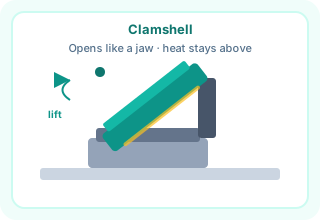
Clamshell — hinged lift
-
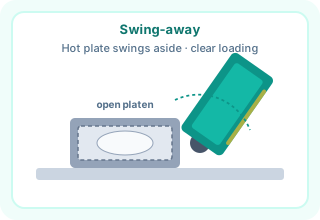
Swing-away — open platen
-
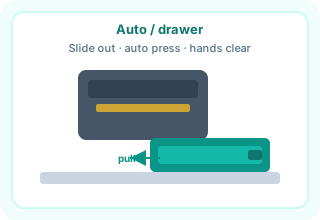
Auto / drawer — slide & press
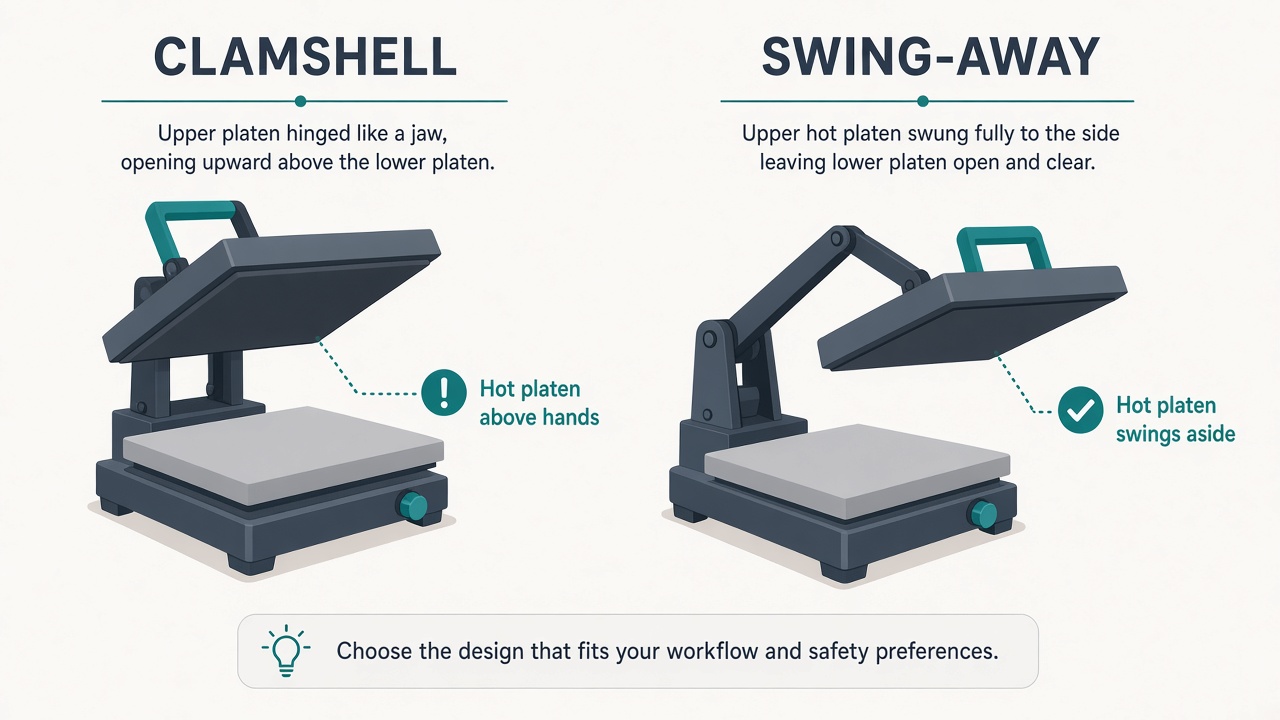
Clamshell
Opens like a jaw: the hot upper platen lifts straight up. When open, heat still sits above your hands while you align vinyl or a transfer.
Pros: Smaller footprint, usually lower price, simple motion.
Cons: More burn risk when rushing; awkward for thick hoodies; pressure can feel uneven if the arm isn’t adjusted carefully.
Best for: Flat tees, limited counter space, budget-first starters who will move slowly and keep a clear workflow.
Swing-away
The hot platen swings fully to the side so the lower platen is open and unobstructed.
Pros: Safer loading, easier alignment, better for layered designs and bulkier garments.
Cons: Needs more depth/side clearance (often cited as roughly 2–3× the machine’s closed footprint for a comfortable swing); typically costs more for comparable build quality.
Best for: Anyone who expects regular hoodie work, multi-layer HTV, or daily order batches—and has the table space.
Auto / drawer-style (bonus category)
Machines like the HTVRONT Auto Heat Press use a slide-out drawer and automatic press/release. They’re not classic swing-aways, but they solve the same beginner problem: keep hands away from a hovering hot plate while reducing pressure guesswork.
Best for: Sellers who want consistency more than maximum raw pressure adjustability (note: first-gen Auto models may have limited/fixed pressure; Auto 2-style units add more control—verify the exact SKU).
Beginner decision tree
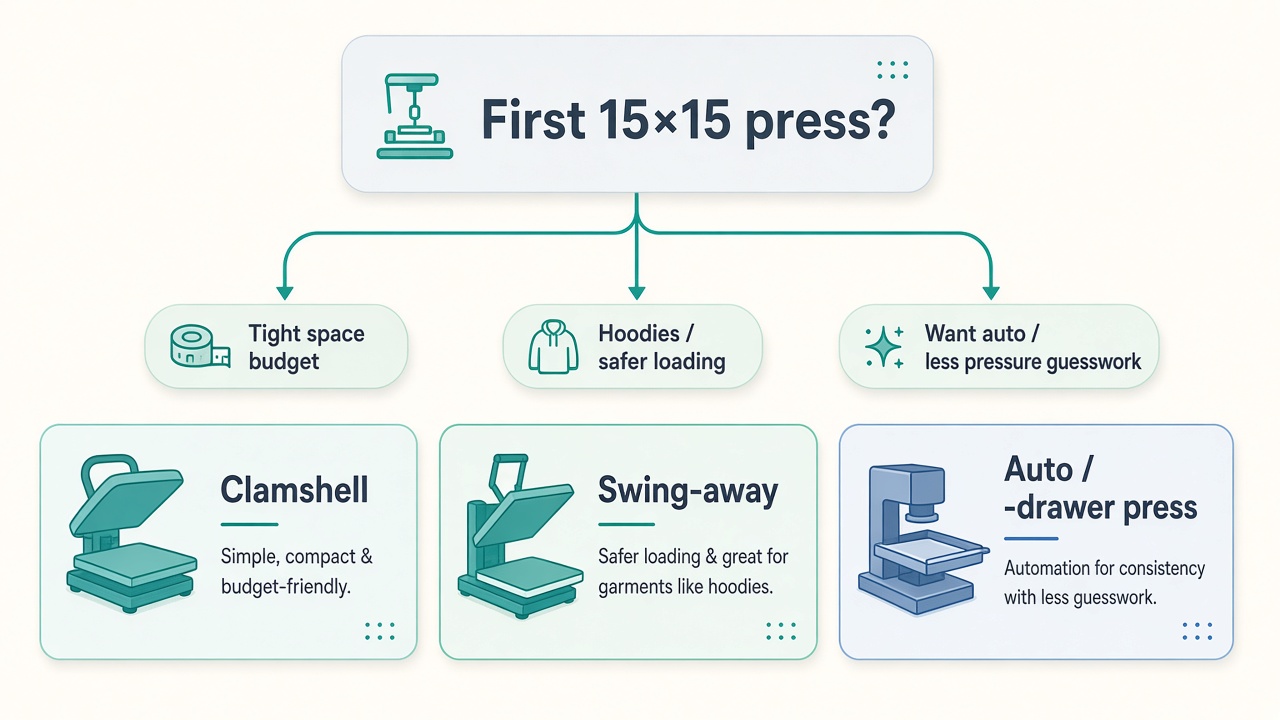
First 15×15 press—what matters most right now?
-
Tight space / budget
Clamshell — simple, compact, and usually the lowest entry price (Fancierstudio, PowerPress).
-
Hoodies / safer loading
Swing-away — open platen for clearer alignment when you have ~30–36"+ table depth (VEVOR 15×15 swing-away).
-
Less technique risk
Auto / drawer — slide-out loading and auto press/release for more repeatable beginner results (HTVRONT Auto).
Rule of thumb: If you’re unsure and space is tight, start clamshell or auto. If you already know apparel is the business—and you have room—skip to swing-away and save yourself an upgrade cycle.
What 15×15 actually means for Etsy
A 15×15-inch platen is the industry sweet spot for custom apparel sellers because it:
- Covers typical adult chest prints (often ~10–12" wide designs) with room to spare
- Handles most tote fronts, pillow panels, and larger youth/adult placements
- Avoids the “outgrew a 9×9 in two weeks” problem that hits many craft-only starters
It is not all-over printing. Full-back stadium graphics, large blanket panels, or oversized fashion prints may need 16×20 or specialty equipment later. For most Etsy tee/hoodie shops in 2026, 15×15 still covers typical chest and back placements.
Etsy workflow fit: List photos sell the design; the press sells the consistency. Customers return when every shirt in an order feels the same. A full platen with adjustable time/temp (and predictable pressure) matters more than owning five niche accessories on day one.
Comparison table
| Model | Type | Approx. power | Max temp (listed) | Approx. price band* | Best for |
|---|---|---|---|---|---|
| VEVOR 15×15 swing-away | Swing-away | ~1000–1400W (varies by SKU) | Often ~410–480°F | $140–$200 (flat/2-in-1); combos higher | Budget sellers who want open platen access |
| Fancierstudio FS15×15 | Clamshell | ~1400W | Up to ~500°F | $175–$190 | Compact starter, flat apparel focus |
| PowerPress Industrial PW15×15 | Clamshell | 1400W | ~455°F | ~$200 | Mid-budget daily tee work |
| HTVRONT Auto Heat Press 15×15 | Auto / drawer | 1500W | ~410°F | $250–$300 new; refurbished often lower | Consistency & lower burn risk |
| HTVRONT Auto Heat Press 2 | Auto + adj. pressure | Check listing | Check listing | Often ~$350+ | Upgrade when volume climbs |
*Approximate retail bands from brand sites and major marketplaces (Amazon, Walmart, VEVOR.com) observed in 2026. Combo kits (mug/hat attachments) inflate price—buy flat-only if apparel is your sole niche.
Top picks (pros, cons, who should buy)
VEVOR 15×15 swing-away
Why it makes the shortlist: Widely listed full-size swing-away under ~$200 on major retailers. Some SKUs advertise dual-tube heating for more even heat—treat those variance claims as marketing until you verify with your materials.
Best for: Budget sellers who want open-platen access and have table swing clearance.
- Swing-away
- 15×15 platen
- ~$140–$200
Pros
- Open-platen alignment
- Beginner-friendly street price
- True 15×15 for adult apparel
Cons
- Easy to overbuy 5-in-1/8-in-1 kits
- QC can vary by batch
- Needs swing clearance
Approx. street price: typically $140–$200
Affiliate link pending — verify live listings on major retailers.
Buy if: You have table space and want swing-away safety without a premium price.
Skip if: Your only surface is a shallow folding table.
Fancierstudio Power Heat Press FS15×15
Why it makes the shortlist: Long marketplace track record as a no-frills 15×15 clamshell with digital time/temp and adjustable pressure. Pull-out lower-platen variants (e.g., FS15×15 BBP) ease loading without a full swing-away.
Best for: Compact starter setups focused on flat apparel.
- Clamshell
- ~1400W
- ~$175–$190
Pros
- Compact vs swing-away
- Typically ~$175–$190
- Listed temps cover common HTV charts
Cons
- Burn risk under hot upper platen
- Manual pressure learning curve
Approx. street price: typically $175–$190
Affiliate link pending — verify live listings on major retailers.
Buy if: Space and price dominate, and you’ll mostly press flat tees.
Skip if: Hoodies and thick blanks are your main SKUs.
HTVRONT Auto Heat Press 15×15
Why it makes the shortlist: Auto press/release and drawer loading target the two biggest beginner failure modes—uneven hand pressure and burns while aligning. Common listings: 15×15, ~1500W, ~410°F max, ~36–38 lb. New units often $250–$300; refurbished lower when stocked.
Best for: Consistency and lower burn risk while validating product-market fit.
- Auto / drawer
- ~1500W
- ~$250–$300 new
Pros
- Fewer ruined blanks while learning
- Clearer load/unload
- Repeatable home-seller settings
Cons
- Costs more than basic clamshells
- ~410°F max may limit niche materials
- Confirm Auto vs Auto 2 for pressure
Approx. street price: typically $250–$300 (new)
Affiliate link pending — verify live listings on major retailers.
Buy if: You want fewer variables while validating product-market fit on Etsy.
Skip if: You’re strictly under a $200 hard cap.
PowerPress Industrial 15×15 (PW15×15)
Why it makes the shortlist: Widely sold 15×15 clamshell (~1400W, digital controls, Teflon-coated platen on many listings) around $200—a step above bare-bones kits without auto pricing.
Best for: Mid-budget daily tee work.
- Clamshell
- 1400W
- ~$200
Pros
- Manual pressure by feel
- Removable silicone mat on many configs
- Solid small-batch tee machine
Cons
- Same clamshell burn/access tradeoffs
- “Industrial” ≠ pneumatic commercial gear
Approx. street price: typically ~$200
Affiliate link pending — verify live listings on major retailers.
Buy if: You’re committed to apparel but not ready for auto pricing.
Skip if: You’ve already decided swing-away is non-negotiable.
HTVRONT Auto Heat Press 2
Why mention it: Public manufacturer and retailer listings in 2026 position Auto 2 as the step-up auto press when you want drawer convenience plus more pressure/height flexibility. Street prices often sit in the mid–high $300s (volatile—verify live).
Best for: Sellers past the first-press stage with climbing volume.
- Auto + adjustable pressure
- Often ~$350+
Pros
- Auto convenience with more control
- Upgrade path as volume climbs
Cons
- Higher price than first-press needs
- Pricing volatile—verify live
Approx. street price: often ~$350+
Affiliate link pending — verify live listings on major retailers.
Buy if: Order volume is climbing and consistency is costing you time.
Skip if: You’re still validating your first 20 Etsy sales.
Starter setup beyond the press
A press alone doesn’t ship orders. Budget for:
- Blank garments you can reorder (same brand/SKU for color consistency)
- Transfer method kit: HTV + weeding tools, or DTF sheets, or sublimation printer + poly-coated blanks (pick one lane first)
- PTFE / Teflon sheet and clean parchment as backup
- Heat-resistant gloves and a dedicated mat or board under/near the press
- Infrared thermometer (optional but useful) to spot-check platen readings vs the display
- Packaging: poly mailers, size stickers, care cards (wash cold, inside-out—reduces returns)
Etsy tip: Shoot photos on the exact blank you sell; update listings if you change blank brands—customers notice hand-feel and color more than platen brands.
Common mistakes (that cost beginners money)
- Buying a tiny “starter” platen—start at 15×15 if apparel is the plan.
- Ignoring swing clearance—a swing-away on a shallow desk becomes a fire-sale item.
- Skipping pressure calibration—too light peels; too heavy leaves shine or crushed foam.
- Trusting the display blindly—spot-check with a thermometer and your material’s chart.
- Combo-kit temptation—mug/hat attachments gather dust if shirts are 95% of revenue.
- Rushing under a hot clamshell—slow down or choose swing-away/auto.
- No test press—always test a scrap before a multi-shirt order.
Basic safety (common sense, not a warranty)
Heat presses can burn skin and scorch fabric. Use a stable heat-resistant surface; keep kids/pets away; don’t leave a hot machine unattended; unplug for long idle periods; follow the manual for heat-up and electrical warnings; use gloves on just-pressed items. This is everyday appliance common sense—not a medical or industrial-safety certification.
FAQ
Is 15×15 enough for an Etsy tee shop?
For most standard adult chest/back designs, yes. Move up if oversized or all-over prints become bestsellers.
Clamshell or swing-away for beginners?
Clamshell if space/budget win. Swing-away if safety, thick garments, and alignment matter—and you have clearance. Auto/drawer is a strong third path.
Can I start with a Cricut EasyPress instead?
Fine for samples, but most sizes are under 15×15 and rely on hand pressure. If apparel is the business, a true 15×15 press is usually the better first business tool.
Does HTV vs sublimation vs DTF change the press choice?
All need even heat and right pressure; match max temp to your material chart. Sublimation needs poly-rich blanks; HTV/DTF are more blank-flexible.
When should I upgrade?
See triggers below.
Upgrade triggers
Move up from a basic clamshell or entry swing-away when you’re pressing daily, failure rates stay high after dialing time/temp, hoodies dominate revenue, 30+ shirt batches fatigue you, or wholesale/fair volume needs faster cycles. That’s when Auto 2-class machines—or eventually pneumatic commercial presses—start paying for themselves.
How we chose (method, not lab theater)
PressDesk shortlisted beginner 15×15 options using: (1) platen size and design class, (2) published specs (wattage, temp, timer, pressure), (3) Etsy apparel use-case fit, (4) approximate 2026 street-price bands from brand/marketplace listings, and (5) known tradeoffs (space, burn risk, combo-kit bloat, pressure learning curve).
We did not invent private lab rankings or “tested in our studio” scores. Prices move—confirm the live listing, warranty, and flat vs combo kit before buying.
Final recommendation
- Tight space + budget: Fancierstudio FS15×15 or PowerPress Industrial PW15×15
- Room to swing + want safer loading: VEVOR 15×15 swing-away
- Want the smoothest beginner path and can spend more: HTVRONT Auto Heat Press 15×15
- Already selling steadily: plan toward Auto 2 or a higher-duty swing-away rather than another ultra-cheap clamshell
Pick the design that matches your table and product mix first—then chase brand names. A well-chosen 15×15 will carry an Etsy apparel shop through validation and early growth; upgrading later is normal, not failure.
Affiliate link — Amazon · Check live prices before you buy.
Affiliate disclosure: PressDesk may earn a commission if you purchase through links on this page, at no additional cost to you.