Clamshell vs Swing-Away Heat Press: Which Is Better for a Home Business?
Clamshell vs swing-away is a geometry and workspace decision—not a universal “best press” contest. Learn how the mechanisms differ, how to measure the space your press actually needs, when thick garments and careful placement make clearer lower-platen access useful, and when a compact clam (or drawer/auto path) is the rational home-business choice.
Home apparel sellers who already know they need a full clamping heat press often get stuck next: clamshell or swing-away? Retailer blogs disagree. Some claim swing-away is always more even and always the safer choice. Others say clamshell is always faster and “good enough.” Neither slogan is useful alone—and this guide does not treat either style as universally safer.
This guide answers a narrower question: for a home business with limited bench space and a mixed (or still-uncertain) product mix, when does a clamshell’s compact, shorter open/close cycle beat a swing-away’s clearer lower-platen access (with the heated upper platen moved aside) and more vertical closing geometry—and when does the swing-away’s operating envelope and thick-substrate behavior justify the extra space, weight, and motion?
Not every clamshell has the same restricted-access feel, and not every swing-away provides the same clearance or pressure behavior. Some wide-opening clamshells (for example, Geo Knight’s DK20 / DK20A class, documented by the manufacturer as engineered for greater lower-table access) raise the rear of the heated platen farther away from the work area than simpler designs. Treat those as documented design examples, not product recommendations—and verify the specific SKU’s clearance and pressure behavior before you buy.
Out of scope here: which 15×15 SKU to buy (Guide 01), which platen size (Guide 06), auto/drawer automation (Guide 03), EasyPress vs full clamp (Guide 02), or method economics (Guide 04). Mechanism first—then shop.
Who this is for
Primary: Home-business / Etsy apparel sellers choosing opening and pressure geometry because of space, hoodies/thick blanks, loading comfort, or conflicting “best” lists.
Secondary: Sellers who own a budget clam and wonder if swing-away would fix hoodie / thick-stack / layered-HTV pain; readers from Guide 01 or 06 who were told “style matters” but not why.
Not primary: Pneumatic production shops; hat/mug specialists; hobby-only crafters.
Quick answer
There is no universal winner. Match mechanism to workspace envelope × garment mix × workflow.
| Your situation | Lean toward |
|---|---|
| Mostly flat tees/totes; tight bench; space/budget dominate | Clamshell (optionally auto-open) |
| Recurring hoodies, thick stacks, layered HTV, careful alignment—and the table clears the swing path | Swing-away |
| Loading without the heated upper platen directly overhead, and without swing-side clearance; you prefer a machine that automates more of the closing/release process | Drawer / auto (Guide 03)—a third path, not “swing-away lite” |
Settle platen size on What Size Heat Press Do I Need? before obsessing over clam vs swing. Ready to shop 15×15 models? Use Best 15×15 Heat Press for Etsy Beginners.
How the mechanisms differ
Clamshell
The upper heat platen is hinged (typically at the rear) and opens like a clam. When open, the hot platen stays above or angled above the lower platen.
The amount of lower-platen access varies substantially by model. Some wide-opening clamshells raise the rear of the heated platen farther away from the work area than simpler designs—Geo Knight’s DK20 / DK20A class is a documented commercial example of a clam engineered for greater lower-table access. That does not mean every premium clam behaves the same, and it is not a product recommendation.
Variations (taxonomy, not shopping): manual clam (dominant budget/home class); auto-open / pop-up clam (opens automatically at the end of the timed cycle on supported models); wide-opening clam (greater lower-table access than shallow jaws on some designs); floating / self-aligning lower platen (mitigates pinch gradient on some trade designs); pull-out lower on a clam frame (clearer lower-platen access while the heated upper platen is moved aside—or, on pull-out designs, while you load away from the overhead heat path—without a full swing arm).
Swing-away
The upper platen lifts and swings clear of the lower platen (often ~90°; some consumer units advertise 360°), then descends more vertically when closed. Classic advantage: layout with the heated upper platen moved away from the layout area—not a guarantee that the work surface has no residual heat.
Variations: manual swing-away; draw/swing hybrids (pull-out lower and/or swing head); pneumatic commercial swingers (rarely day-one for home shops); combo multi-attachment kits (easy to overbuy attachments you will not sell).
Taxonomy lock
Clamshell and swing-away are the two classic manual frame geometries. Drawer/auto machines are a third loading/automation class that can solve overhead-heat loading problems without a swing arm—Guide 03, not re-litigated here.
Comparison table (qualified)
Tendencies below are geometry and workflow patterns from manufacturer/trade education—not PressDesk lab rankings, and not guarantees for every SKU.
| Factor | Clamshell | Swing-away | Qualification |
|---|---|---|---|
| Closed footprint | Often compact | Often similar closed footprint | Listed dims ≠ operating envelope |
| Moving envelope | Open-jaw height + front reach | Swing arc + raised-head height + front apron | Closed dimensions can fit while the swing path does not. |
| Loading / layout | Work under or near hot platen | Full view with heated upper platen moved aside | Pull-out clam hybrids blur this line; residual heat on the lower surface is still possible |
| Cycle motion | Up/down — fewer steps | Swing out + in + clamp — more steps | Motion tax ≠ invented shirts/hour |
| Thick / uneven stacks | Angular close can bias contact toward the hinge side | More vertical close reduces that tendency | Style ≠ even PSI; setup still matters |
| Cost / weight pattern | Often lighter/cheaper at trade grade | Heavier/costlier at commercial grade | Budget marketplace prices often converge—space decides |
| Heat proximity when open | Hot platen overhead / nearby | Heated upper platen can be moved away from the layout area | Proximity fact—not an injury-rate claim; not a “cold surface” guarantee |
| Dressing garments | Shallow jaws harder on bulky goods | Open lower table often easier | Frame/stand design matters as much as style; wide-opening clams vary |
Machine names later are geometry exemplars with dated bands—not awards.
The Space Your Press Actually Needs
Marketplace “product dimensions” describe the box or closed machine. A swing-away can fit the table on paper yet still be impractical if the arm cannot clear walls, shelves, cords, or the operator.
Do not use a blind “2×” or “3× closed footprint” rule. Older rough multipliers (including prior PressDesk planning language) over-claim a universal multiplier. Measure instead.
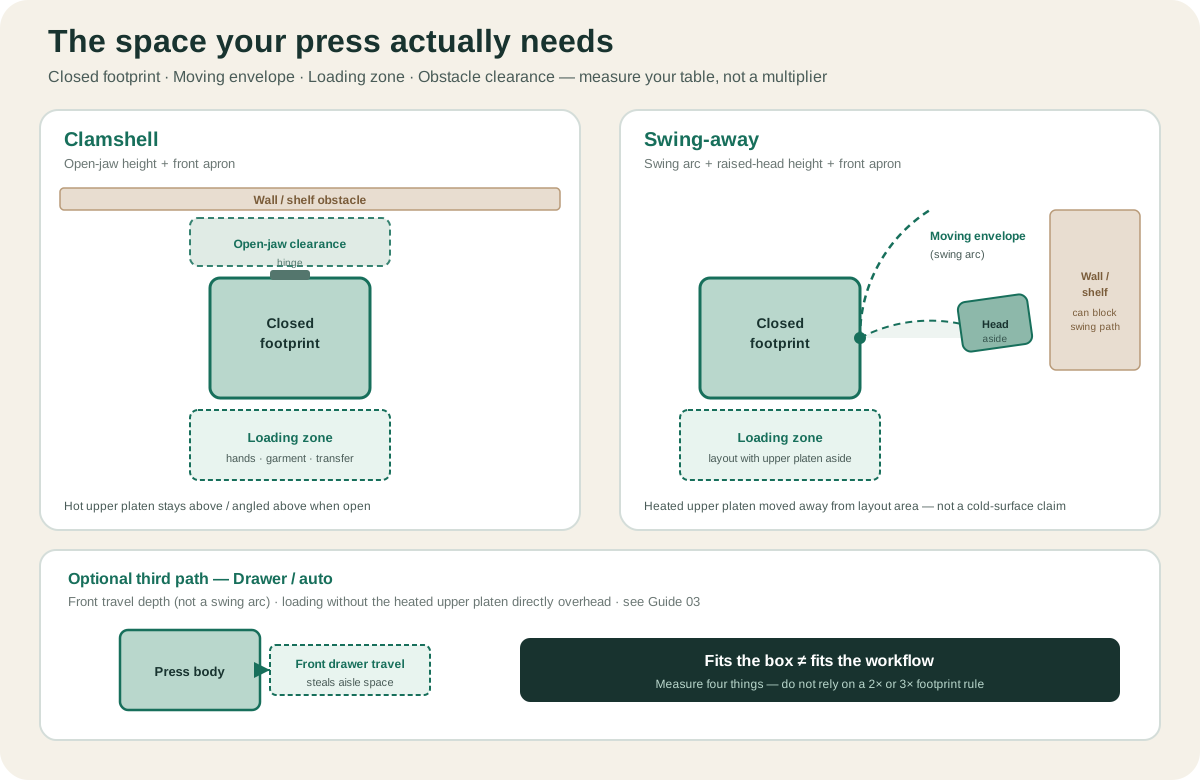
Four measurements (PressDesk planning method)
- Closed footprint — Length × width of the machine clamped shut (listing dims are approximate). Confirm the table covers the base with margin.
- Moving envelope — Volume while operating:
- Clam: height and rear clearance at full open jaw; any hinge overhang.
- Swing: raised-head height plus the full swing arc at every angle you will use.
- Pull-out / drawer hybrids: front travel depth when the lower platen is fully extended (not a swing arc—still steals aisle space).
- Loading zone — Clear space in front of the lower platen for hands, garment, transfer, and alignment tools. Leave enough clear space in front of the platen to position and dress the largest garment you normally expect to press without hitting a wall, shelf, neighboring machine, or aisle obstruction. Evaluate this against the actual machine and workspace rather than using a universal clearance number. If you cannot dress a hoodie without hitting a wall, it “fits” on paper and fails in workflow.
- Obstacle clearance — Walls, shelves, monitors, power strips, and cord path. Swing arms and clam handles both need clear motion; manuals warn against clamping a cord. Some commercial swing-away presses are very heavy, so confirm the specific machine’s listed weight and any bench or bolting requirements before choosing a work surface.
Heuristics (analysis, not tested standards)
| Scenario | Prefer |
|---|---|
| Shallow table against a wall; little side clearance | Clam or drawer/auto |
| Table island with clear swing side + open front | Swing viable |
| Weak shared/folding top | Avoid heavy commercial swing; lighter clam/auto + dedicated board |
| Hoodie-heavy mix + adequate envelope | Swing (or wide-open / pull-out clam) |
| Flat-tee volume + tight room | Clam (optionally auto-open) |
Illustrative envelopes (verify live; ~2026-09-16)
| Exemplar | Style | Envelope note |
|---|---|---|
| PowerPress / Fancierstudio 15×15 clam class | Clam | Plan overhead for open jaw; closed dims vary by listing |
| VEVOR 15×15 clam class | Clam | Compact closed; still needs open-jaw height |
| VEVOR TL1515-class 15×15 swing | Swing | Needs side swing clearance; “360°” marketing ≠ free walls |
| HTVRONT Auto / Auto 2 class | Drawer auto | Needs front drawer travel—Guide 03 |
| Geo Knight DK20 / DK20A vs DK20S | Wide-opening clam / swing sibling | DK20/DK20A class documents greater lower-table access than shallow clam jaws; sibling commercial footprints can look similar closed—weight + swing path are the real swing costs |
Takeaway: Fits-the-box ≠ fits-the-workflow. The four measurements decide—not a footprint multiplier.
Loading and transfer placement
Clamshell: Align under or near a hot upper platen. Flat tees and simple single-layer HTV are manageable with practice. Layered designs, name/number work, and bulky garments are harder—heat and limited jaw opening constrain visibility and dressing on many models. Wide-opening designs can improve access without changing style class.
Swing-away: Swing the head aside, lay out with the heated upper platen moved away from the layout area, then swing back and clamp. Moving the heated upper platen aside can provide clearer visibility and lower-platen access when positioning hoodies, seams, or multi-piece HTV. This describes platen position and access, not a claim that the lower surface is free of residual heat, and not a safety or injury-rate claim.
Both styles: Keep collars, zippers, buttons, and thick seams off the pressure pad when possible—bulky parts on the pad steal effective pressure. Threadability (pulling a garment over a free lower table) depends on frame and stand design, not clam vs swing alone.
Pressure geometry: why “swing = automatically more even pressure” is wrong
Retailer blogs often claim swing-away applies pressure “straight down” and is therefore more even—“swing = automatically more even pressure.” That oversells the mechanism.
What geometry actually does
- A clamshell closes on an arc. On thick or uneven stacks, the hinge side can contact first—a pinch tendency toward the rear/neck edge. Severity depends on thickness, hinge design, floating/self-aligning lowers, and where pressure is applied.
- A swing-away typically descends more vertically, which reduces that geometric tendency on thick/uneven goods. That is a real mechanical advantage in the right jobs.
- Geometry can influence contact, but contact quality also depends on over-center / center pressure adjustment, platen construction and alignment, and pad condition.
What geometry does not do
Swing geometry does not automatically guarantee even pressure.
- Some trade buying guides (e.g., Stahls) describe evaluating contact with center / over-center pressure adjustment and a four-corner paper-drag / pull test. Treat that as trade guidance for both styles when relevant—not a universal manufacturer-approved procedure for every press. Prefer your exact machine’s manual.
- Some clam designs use a floating lower platen specifically to mitigate angular pinch—design can reduce the defect without switching styles.
- Platen construction, alignment, and pad condition affect contact on either style—build and maintenance matter as much as frame geometry.
- PressDesk has no private PSI maps. Brand “even heating / even pressure” marketing is not lab proof.
Language lock: Vertical close reduces the geometric tendency toward rear-biased contact on thick items; it does not guarantee even pressure. Construction, pressure-mount location, pad condition, and setup matter as much as clam vs swing.
HTV and DTF (short)
Transfer chemistry does not force clam vs swing. Both methods need correct time / temperature / pressure per material or supplier instructions. Mechanism only changes how easily you deliver even contact and accurate placement.
| Job | Mechanism relevance |
|---|---|
| Single-layer HTV on flat tees | Clam often workable; space/cycle simplicity can matter more than style |
| Layered / multi-piece HTV | Clearer lower-platen access while the heated upper platen is moved aside (swing or drawer) can help visibility |
| Outsourced DTF on flat tees | Either style OK if pressure is even and settings match supplier |
| DTF on hoodies / seams / thick stacks | More vertical closing geometry + clearance can help; still follow supplier pressure |
Optional note on rigid / thicker substrates: Some rigid or thicker substrates can make unobstructed access and more vertical closing useful, but suitability is tied to the specific machine’s documented clearance, pressure adjustment, and supported applications—not a universal swing-away claim.
Do not claim: “DTF requires swing-away” or “HTV requires clamshell.”
Method economics: DTF vs HTV for Cotton Etsy Tees. A future best press for DTF shortlist belongs in planned Guide 08—not this mechanism deep dive.
Workflow and motion tax
Trade consensus: a clam has fewer motion steps per cycle (primarily up/down). A swing adds swing-out, align, swing-in, and clamp.
For mostly flat tees, extra motions can add up across a session. Whether those extra swing motions matter depends on the seller’s actual workflow—compare press-cycle motion with transfer preparation, garment setup, finishing, packing, and other production steps. Do not treat any one step as a universal bottleneck, and do not invent volume thresholds or measured throughput.
Language lock: Describe cycle steps and rhythm—do not invent shirts-per-hour numbers. Total output still depends on prep, cure rules, and finishing. Auto-open clams change the attention tax, not clam-vs-swing geometry.
Third path: drawer / auto (brief)
Slide-out lower drawer + machine-driven press/release (HTVRONT Auto-class and peers) are not classic swing-aways. They solve overhead-heat loading differently: pull the platen toward you, load without the heated upper platen directly overhead, then let the machine handle press/release consistency.
Choose this when you want clearer lower-platen access while the heated upper platen is moved aside (or while the lower platen is pulled clear of the overhead heat path) without swing-side clearance, or when you prefer a machine that automates more of the closing/release process. Full auto vs manual comparison—including Auto vs Manual detail—belongs in Auto vs Manual Heat Press (Guide 03).
Who should buy which
Clamshell if: recent paid orders (and near-term plans) are mostly flat tees/totes; a wall blocks any realistic swing arc; you want the most compact full clamp you can still calibrate; hoodies are occasional rather than a recurring core SKU. Prefer evidence from your mix and your table—not a universal clam rule.
Swing-away if: hoodies, thick stacks, layered HTV, or similar alignment-critical work are recurring paid work; you have measured moving envelope + loading zone + obstacles and they clear; alignment visibility matters more than saving swing motions; you accept more weight (and often more cost at trade grade). Again: fit to measured envelope and mix, not a slogan.
Drawer/auto if: you want loading without the heated upper platen directly overhead but fail the swing-arc test, or you prefer a machine that automates more of the closing/release process—see Guide 03.
Not all clams or swings are equal. A wide-opening or floating-platen clam differs from a shallow budget jaw. A light marketplace swing does not automatically deliver commercial thick-capacity benefits. Buy build class and verifiable features, not buzzwords.
Decision framework (7 steps)
- Confirm full clamp + platen size first — Handheld? Guide 02. Size class? Guide 06. Size before style.
- Measure the four space dimensions — Closed footprint, moving envelope, loading zone, obstacle clearance. Swing arc blocked → eliminate classic swing (clam, pull-out clam, or drawer auto).
- Score substrate mix — Mostly flat tees/totes often make a clam a workable fit when space is tight. Recurring thick, layered, or alignment-critical goods can make swing (or wide-open / pull-out access) more useful if the envelope allows. Uncertain mix → choose swing only when measured clearance supports it; otherwise clam/auto and revisit when the mix clarifies.
- Weigh motion steps vs your actual rhythm — Flat-tee–heavy sessions can make fewer clam motions attractive; alignment-critical or thick-stack work can make swing’s extra steps acceptable when visibility and dressing matter more. Do not invent shirts-per-hour cutoffs—judge against your prep, curing, and finishing time.
- Third-path check — Need loading without the heated upper platen directly overhead and without swing room, or prefer a machine that automates more of the closing/release process → Guide 03.
- Separate style from build quality — Pressure adjustment, pad serviceability, warranty, watts/temp, bench needs. Marketing “even pressure” ≠ a verified contact check from your machine’s manual.
- Shop models only after the mechanism fits — 15×15 shortlists: Guide 01. This guide crowns no product winner.
Output pattern: For your garment mix and your table envelope, clam or swing is the better fit—not the better machine in the abstract.
Common mistakes
- Buying swing-away for a wall-flush desk because closed dims “fit.”
- Assuming swing-away automatically fixes uneven pressure—skipping the manufacturer’s pressure adjustment and any contact check that manual specifies.
- Confusing platen size with mechanism.
- Using a 2×/3× footprint rule instead of measuring arc, open-jaw height, loading zone, and obstacles.
- Overbuying 5-in-1 / 8-in-1 kits when you only sell flat apparel.
- Treating “DTF requires swing” (or “HTV requires clam”) as fact.
- Ignoring cord path and bench stability—especially on heavier swings.
- Expecting a budget swing to match commercial thick-capacity claims without reading that SKU’s limits.
- Treating all clamshells (or all swing-aways) as identical in access and pressure behavior.
FAQ
Is swing-away better than clamshell?
Neither is universally better. Space, mix, and workflow decide. Not every clam feels equally restricted, and not every swing offers the same clearance or pressure behavior.
Does swing-away give more even pressure?
Often better closing geometry on thick/uneven goods—not automatic even pressure. Construction, alignment, pad condition, and manufacturer-directed pressure/contact checks matter for both styles.
Can a clamshell do hoodies?
Often yes for occasional hoodies with careful dressing and bulky parts off the pad. When thick/uneven paid work is recurring, clearer lower-platen access and more vertical closing (swing, or a wide-open / pull-out hybrid) can be a better fit if the envelope allows—without treating that as a universal rule.
How much space does a swing-away need?
More than closed listing dims. Measure moving envelope + loading zone + obstacles—no universal 2× rule and no universal front-apron inch count.
Is drawer/auto the same as swing-away?
No. Third class—Guide 03.
Do I need swing-away for DTF?
Not inherently. Follow supplier instructions. Thick/uneven DTF jobs may benefit from swing geometry; flat-tee DTF does not require it. Planned DTF-press shopping → future Guide 08.
Which is better for beginners?
Space/budget + flat tees → clam or drawer/auto is often a practical fit. Clearance + thick/alignment-critical work → swing can be a better fit when measured. Then shop Guide 01.
Will I outgrow a clamshell?
Possibly if paid mix shifts to thick/hard or layout-critical work—not automatically because you “went pro.”
Does heavier mean better?
No. Serviceable construction, pads, warranty, and duty cycle matter more than pounds alone.
Methodology
Built from manufacturer pages/manuals (Geo Knight DK20 / DK20A / DK20S / DK20SP class), brand education (Hotronix style guides; Stahls buying guidance describing center pressure and four-corner paper checks as trade examples), and trade education (Graphics Pro / HIX-sponsored style analysis; SignWarehouse; HeatPressNation; Joto). Marketplace listings (PowerPress, Fancierstudio, VEVOR, HTVRONT class) are geometry and price-band exemplars, not awards.
No private PressDesk press lab. No invented PSI maps. No shirts-per-hour benchmarks. No injury-rate claims. Pressure language is geometric tendency + setup practice. Safety language is heat proximity and motion path, not epidemiology. Space guidance replaces footprint multipliers with a four-measurement method. Price/context bands dated ~2026-09-16—verify live.
Conclusion
- No universal winner — fit mechanism to envelope × mix × workflow.
- Model variation matters — not every clam restricts access the same way; not every swing clears or presses the same way.
- Measure four things — closed footprint, moving envelope, loading zone, obstacle clearance.
- Vertical close helps thick/uneven stacks — it does not grant automatic even pressure.
- Clam fits many flat-tee, tight-space home shops.
- Swing fits when clearance exists and thick/alignment-critical work recurs.
- Drawer/auto is a third path—Guide 03.
- Size first (Guide 06), then style (here), then SKUs (Guide 01).