Best 15×15 Heat Press for Etsy Beginners (2026 Buyer’s Guide)
Best 15×15 heat press picks for Etsy beginners—shortlists, price bands, and a decision tree for spare-room studios. Mechanism overview here; full clamshell vs swing-away comparison in our dedicated guide.
Starting an Etsy shop for custom tees, hoodies, or tote bags usually lands you at the same question: which 15×15 heat press should you buy first? Design class (clamshell, swing-away, or auto/drawer) still matters for shortlists—but this page is the shopping guide, not the full mechanism deep dive.
This guide is for beginners who need a press for real Etsy orders—not just weekend crafts—without jumping to commercial shop gear. We evaluated options by platen size and design, heat/pressure controls, footprint, published street-price bands, and Etsy workflow fit (sample → list → batch → ship).
Not sure 15×15 is the right size yet? Start with 9×9 vs 12×10 vs 15×15 vs 16×20, then return here for the machine shortlist. Still choosing clamshell vs swing-away geometry? See Clamshell vs Swing-Away Heat Press for the full workspace and pressure comparison—then shop the shortlists below.
We did not run lab tests or invent “we pressed 200 shirts” claims. Picks are research-backed shortlists of widely sold 15×15 models on major retailers, matched to published specs, street-price bands, and common beginner buying criteria as of 2025–2026.
Quick picks
| Need | Pick | Style | Approx. street price* |
|---|---|---|---|
| Best value swing-away | VEVOR 15×15 swing-away (flat or 2-in-1) | Swing-away | Roughly mid–high $100s to ~$200 (verify live) |
| Best budget clamshell | Fancierstudio Power Heat Press FS15×15 | Clamshell | Roughly high $100s (verify live) |
| Easiest learning curve | HTVRONT Auto Heat Press 15×15 | Auto / drawer-style | Roughly mid–high $200s new (volatile—verify live) |
| Solid mid-range daily driver | PowerPress Industrial 15×15 (PW15×15) | Clamshell | Roughly around ~$200 (verify live) |
| Hands-free upgrade | HTVRONT Auto Heat Press 2 15×15 | Auto with adjustable pressure | Often around ~$350 (kits higher; verify live) |
*Prices are approximate guidance only, drawn from manufacturer and major-retailer listings observed around mid–late 2026. Street prices are volatile (promos, kits, and refurbished stock move the needle)—confirm live before checkout.
Who this guide is for
You’re in the right place if you:
- Are launching or growing an Etsy apparel niche (HTV, DTF, sublimation blanks)
- Need one primary press for adult tees through ~2XL / 3XL chest designs
- Work from a spare room, garage corner, or small studio—not a production floor
- Want to understand clamshell vs swing-away before spending $150–$350
Look elsewhere (for now) if you:
- Already run dozens of presses a day and need pneumatic / air-assisted commercial gear
- Only decorate tiny items (hats, baby onesies)—a smaller platen or EasyPress-style tool may be enough at first
- Need all-over prints or very large backs—you may outgrow 15×15 toward 16×20 later
Clamshell vs swing-away: buying context for 15×15 shortlists
Your first 15×15 usually falls into one of three design classes. This section is a buying-context summary so the shortlists below make sense—not a full mechanism comparison. For workspace envelopes, pressure geometry, and thick-garment tradeoffs, read Clamshell vs Swing-Away Heat Press.
-
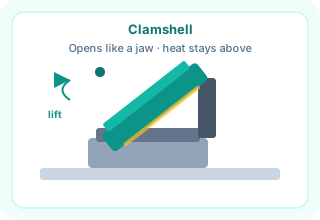
Clamshell — hinged lift
-
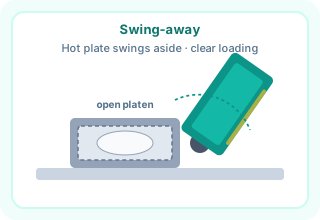
Swing-away — open platen
-
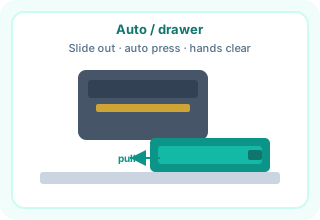
Auto / drawer — slide & press
Clamshell (buying summary)
Hinged jaw; usually the most compact and budget-friendly 15×15 class. Hot upper platen stays above or angled above the lower platen when open. Strong fit for flat tees, tight counters, and budget-first starters who will move carefully.
Swing-away (buying summary)
Upper platen swings aside so the lower platen is clearer for loading and alignment—especially useful for hoodies and layered designs when your table clears the swing path. Check the exact machine dimensions and swing arc against your workspace before buying; typically costs more for comparable build quality.
Auto / drawer-style (bonus category)
Machines like the HTVRONT Auto Heat Press use a slide-out drawer and automatic press/release. They’re not classic swing-aways, but they solve a common beginner problem: load without the heated upper platen directly overhead while reducing pressure guesswork. First-gen Auto models may have limited/fixed pressure; Auto 2-style units add more control—verify the exact SKU. Full auto vs manual detail: Auto vs Manual Heat Press.
Beginner decision tree
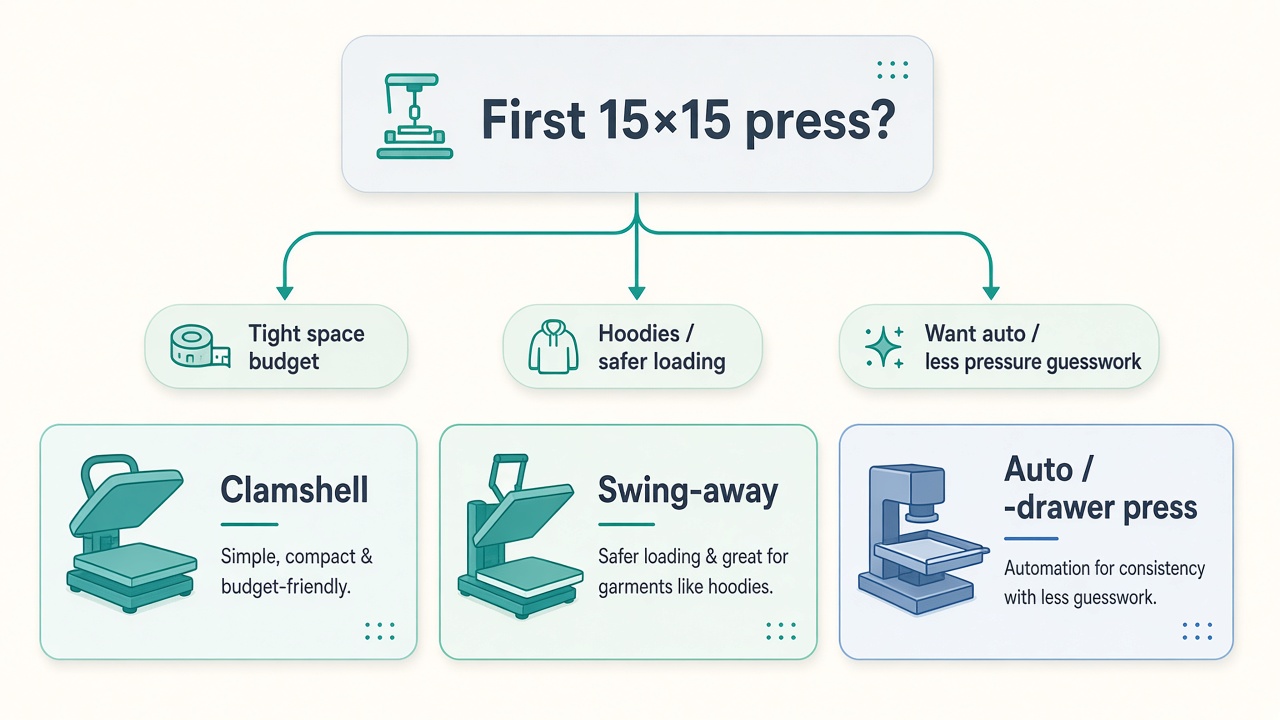
First 15×15 press—what matters most right now?
-
Tight space / budget
Clamshell — simple, compact, and usually the lowest entry price (Fancierstudio, PowerPress).
-
Hoodies / open-platen loading
Swing-away — open platen for clearer alignment when your work surface fits the selected machine’s dimensions, swing path, and required clearance (VEVOR 15×15 swing-away).
-
Less manual pressure dialing
Auto / drawer — slide-out loading and auto press/release so fewer pressure settings sit with the operator (HTVRONT Auto).
Rule of thumb: If you’re unsure and space is tight, start clamshell or auto. If you already know apparel is the business—and you have measured clearance—PressDesk often plans toward swing-away based on expected garment mix, loading preference, space, and workflow. That is a planning recommendation, not a guarantee you will avoid a later upgrade. For the full geometry and space method, use the clamshell vs swing-away guide.
What 15×15 actually means for Etsy
A 15×15-inch platen is a practical general-purpose size for many custom-apparel workflows because it:
- Covers typical adult chest prints (often ~10–12" wide designs) with room to spare
- Handles most tote fronts, pillow panels, and larger youth/adult placements
- Leaves more room when a catalog expands into larger adult chest/back designs that can outgrow smaller platens
It is not all-over printing. Full-back stadium graphics, large blanket panels, or oversized fashion prints may need 16×20 or specialty equipment later. For most Etsy tee/hoodie shops in 2026, 15×15 still covers typical chest and back placements.
Etsy workflow fit: List photos sell the design; the press sells the consistency. Repeatable application—time, temperature, pressure, and placement—matters for consistent paid orders. A full platen with adjustable time/temp (and predictable pressure) matters more than owning five niche accessories on day one.
Comparison table
| Model | Type | Approx. power | Max temp (listed) | Approx. price band* | Best for |
|---|---|---|---|---|---|
| VEVOR 15×15 swing-away | Swing-away | ~1000–1400W (varies by SKU) | Often ~410–480°F | Roughly mid–high $100s–~$200 (flat/2-in-1); combos higher | Budget sellers who want open platen access |
| Fancierstudio FS15×15 | Clamshell | ~1400–1500W (varies by revision) | Up to ~500°F (listed) | Roughly high $100s | Compact starter, flat apparel focus |
| PowerPress Industrial PW15×15 | Clamshell | 1400W | ~455°F | Roughly around ~$200 | Mid-budget daily tee work |
| HTVRONT Auto Heat Press 15×15 | Auto / drawer | 1500W | ~410°F | Roughly mid–high $200s new; refurbished often lower | Auto press/release & drawer loading |
| HTVRONT Auto Heat Press 2 | Auto + adj. pressure | ~1500W (published) | ~410°F max (published) | Often around ~$350; kits higher | Upgrade when volume / pressure control needs climb |
*Approximate retail guidance from brand sites and major marketplaces (Amazon, Walmart, VEVOR.com) observed in 2026—prices move. Combo kits (mug/hat attachments) inflate price—buy flat-only if apparel is your sole niche. Confirm wattage/temp for the exact VEVOR or Fancierstudio SKU you open.
Top picks (pros, cons, who should buy)
VEVOR 15×15 swing-away
Why it makes the shortlist: Widely listed full-size swing-away often in the mid–high $100s to ~$200 on major retailers. Specs (wattage, max temp, warranty) vary by SKU—do not assume one VEVOR listing matches another. Some SKUs advertise dual-tube heating for more even heat—treat those claims as marketing until you verify with your materials.
Best for: Budget sellers who want open-platen access and have table swing clearance.
- Swing-away
- 15×15 platen
- Roughly mid–high $100s–~$200
Pros
- Open-platen alignment
- Beginner-friendly street price
- True 15×15 for adult apparel
Cons
- Easy to overbuy 5-in-1/8-in-1 kits
- Wattage/temp ranges vary by SKU—verify listing
- Needs swing clearance
Approx. street price: roughly mid–high $100s to ~$200 (verify live)
Buy if: You have table space and want open-platen (swing-away) loading without a premium price.
Skip if: Your only surface is a shallow folding table.
Fancierstudio Power Heat Press FS15×15
Why it makes the shortlist: Long marketplace track record as a no-frills 15×15 clamshell with digital time/temp and adjustable pressure. Listings commonly cite ~1400W (some newer color revisions list ~1500W)—verify the exact SKU. Pull-out lower-platen variants (e.g., FS15×15 BBP) ease loading without a full swing-away.
Best for: Compact starter setups focused on flat apparel.
- Clamshell
- ~1400–1500W (by revision)
- Roughly high $100s
Pros
- Compact vs swing-away
- Typically high $100s street
- Listed temps cover common HTV charts
Cons
- Hot upper platen stays above loading area
- Manual pressure learning curve
Approx. street price: roughly high $100s (verify live)
Buy if: Space and price dominate, and you’ll mostly press flat tees.
Skip if: Hoodies and thick blanks are your main SKUs.
HTVRONT Auto Heat Press 15×15
Why it makes the shortlist: Auto press/release and drawer loading reduce manual pressure settings the operator controls and keep hands away from a hovering hot plate during load/unload. Published specs commonly list 15×15, ~1500W, ~410°F max, ~36–38 lb. Street/official pricing is volatile—often roughly mid–high $200s for new units (kits and promos vary; verify live).
Best for: Automatic press/release and drawer loading while validating product-market fit.
- Auto / drawer
- ~1500W
- Roughly mid–high $200s new
Pros
- Automatic press/release (less manual pressure dialing)
- Clearer load/unload
- Repeatable home-seller settings
Cons
- Costs more than basic clamshells
- ~410°F max may limit niche materials
- Confirm Auto vs Auto 2 for pressure
Approx. street price: roughly mid–high $200s new (volatile—verify live)
Buy if: You want fewer variables while validating product-market fit on Etsy.
Skip if: You’re strictly under a $200 hard cap.
PowerPress Industrial 15×15 (PW15×15)
Why it makes the shortlist: Widely sold 15×15 clamshell (published ~1400W, digital controls, Teflon-coated platen on many listings) often around ~$200—a step above bare-bones kits without auto pricing.
Best for: Mid-budget daily tee work.
- Clamshell
- 1400W
- ~$200
Pros
- Manual pressure by feel
- Removable silicone mat on many configs
- Solid small-batch tee machine
Cons
- Same clamshell access tradeoff (hot platen above work area)
- “Industrial” ≠ pneumatic commercial gear
Approx. street price: roughly around ~$200 (verify live)
Buy if: You’re committed to apparel but not ready for auto pricing.
Skip if: You’ve already decided swing-away is non-negotiable.
HTVRONT Auto Heat Press 2
Why mention it: Public manufacturer listings position Auto 2 as the step-up auto press with drawer convenience plus adjustable pressure (published ~20–80 kg) and higher heating height (~4.5 cm). Official standard-kit pricing has been around ~$349.99; kits and promos vary—verify live.
Best for: Sellers past the first-press stage with climbing volume.
- Auto + adjustable pressure
- Often around ~$350
Pros
- Auto convenience with more control
- Upgrade path as volume climbs
Cons
- Higher price than first-press needs
- Pricing volatile—verify live
Approx. street price: often around ~$350 (verify live)
Buy if: Order volume is climbing and consistency is costing you time.
Skip if: You’re still validating your first 20 Etsy sales.
Comparing this Auto Heat Press 2 with another current 15×15 automatic drawer press? See our HTVRONT Auto Heat Press 2 vs VEVOR AP-999 comparison for the exact-model pressure controls, clearance, and workspace differences.
Starter setup beyond the press
A press alone does not complete the workflow, but you do not need a giant accessory bundle. Start with the shared core, add only the tools required by your chosen method, and buy pillows, platen covers, alignment systems, or specialty tools when they solve a recurring constraint.
Use the dedicated heat press starter setup checklist for the full HTV versus purchased-DTF breakdown, protective-sheet rules, workspace considerations, and staged buying plan.
Common mistakes (that cost beginners money)
- Buying a tiny “starter” platen without checking design size—PressDesk often recommends 15×15 as a practical general-purpose starting size for many apparel sellers, but the right platen depends on the designs, placements, garment sizes, space, and products you actually expect to sell. Compare options in the heat-press size guide.
- Ignoring swing clearance—a swing-away needs enough room for its swing path. Compare the exact machine dimensions and motion envelope with your available workspace before buying.
- Skipping pressure set/test—set and test pressure per the exact product instructions. Outcomes depend on transfer/material, time, temperature, garment, coverage, and manufacturer guidance—not guaranteed peel, shine, or crushed foam from “too light” or “too heavy” alone.
- Treating the display as the only check—follow your material’s chart and manufacturer controls. An IR thermometer is an optional, method-sensitive cross-check only (emissivity, surface, distance, angle, and method all affect readings)—not definitive platen-temp verification and not required for beginner setup.
- Combo-kit temptation—if nearly all of the products you plan to sell are flat apparel, unused mug or hat attachments may add cost and storage without helping your current workflow. (Hypothetical PressDesk planning example—not seller data.)
- Rushing under a hot clamshell—slow down or choose swing-away/auto.
- No test press—always test a scrap before a multi-shirt order.
Basic safety (common sense, not a warranty)
Heat presses can burn skin and scorch fabric. Use a stable heat-resistant surface; keep kids/pets away; don’t leave a hot machine unattended; unplug for long idle periods; follow the manual for heat-up and electrical warnings; use gloves on just-pressed items. This is everyday appliance common sense—not a medical or industrial-safety certification.
FAQ
Is 15×15 enough for an Etsy tee shop?
For most standard adult chest/back designs, yes. Move up if oversized or all-over prints become bestsellers.
Clamshell or swing-away for beginners?
Clamshell if space/budget win. Swing-away if you want the hot platen moved aside for thick garments and clearer alignment—and you have clearance. Auto/drawer is a strong third path.
Can I start with a Cricut EasyPress instead?
Fine for samples, but many EasyPress-class plates are under 15×15 and use hand pressure. For many apparel sellers, PressDesk recommends a conventional 15×15 as a practical general-purpose starting size—but the right platen still depends on the designs, placements, garment sizes, space, and products you expect to sell. See the heat-press size guide.
Does HTV vs sublimation vs DTF change the press choice?
Application needs depend on the exact HTV, DTF, or sublimation product: follow that product’s or transfer supplier’s instructions for time, temperature, pressure, peel, pre-press, cover sheet, and care—those settings are not universal. Sublimation generally needs poly-rich blanks; HTV/DTF blank rules also vary by product chart. For DTF-specific capability fit (instruction variance, pressure/temp shortlists), see Best Heat Press for DTF Transfers.
When should I upgrade?
See triggers below.
Upgrade triggers
Move up from a basic clamshell or entry swing-away when you’re pressing daily, operator fatigue from large batches becomes an issue, thick garments dominate revenue, or you need greater pressure control than your current machine allows. Higher volume and those workflow limits are common reasons to evaluate Auto 2-class machines—or eventually pneumatic commercial presses—not a guaranteed financial payback without your own cost analysis.
How we chose (method, not lab theater)
PressDesk shortlisted beginner 15×15 options using: (1) platen size and design class, (2) published specs (wattage, temp, timer, pressure), (3) Etsy apparel use-case fit, (4) approximate 2026 street-price bands from brand/marketplace listings, and (5) known tradeoffs (space, platen position when open, combo-kit bloat, pressure learning curve).
We did not invent private lab rankings or “tested in our studio” scores. Prices move—confirm the live listing, warranty, and flat vs combo kit before buying.
Final recommendation
- Tight space + budget: Fancierstudio FS15×15 or PowerPress Industrial PW15×15
- Room to swing + want open-platen loading: VEVOR 15×15 swing-away
- Want the smoothest beginner path and can spend more: HTVRONT Auto Heat Press 15×15
- Already selling steadily: plan toward Auto 2 or a higher-duty swing-away rather than another ultra-cheap clamshell
Pick the design that matches your table and product mix first—then chase brand names. A well-chosen 15×15 will carry an Etsy apparel shop through validation and early growth; upgrading later is normal, not failure.